

Eighteen years of sobriety and a pandemic-fueled career pivot have shaped Bridget's understanding of entrepreneurship, leadership, and the delicate art of work-life balance.
















































Embark with me on a journey from the halls of Notre Dame, through the world of dance, and into the heart of Bridge to Freedom Coaching. Eighteen years of sobriety and a pandemic-fueled career pivot have shaped Bridget's understanding of entrepreneurship, leadership, and the delicate art of work-life balance.
Transcripts: https://www.buzzsprout.com/2242998/14245844
EPISODE LINKS:
Bridge to Freedom: https://www.bridgetofreedomcoaching.com/
Bridget's Linkedin: https://www.linkedin.com/in/bridget-hom-b55600192
Bridget's Instagram: https://www.instagram.com/bridget_hom
Bridget's YouTube: https://www.youtube.com/channel/UCDI0LiLfuNnqy1fSqXGpPoA
Bridget's TikTok: https://www.tiktok.com/@bridgethom
Bridget's Twitter: https://twitter.com/HomBridget
Stuck On Ready: https://www.amazon.com/stores/Bridget-Hom/author/B0BGQP9ZGS
OUTLINE:
The episode's timestamps are shown here. You should be able to jump to that time by clicking the timestamp on certain podcast players.
(00:00) - Balancing Work and Relationships During COVID
(02:57) - Self-Awareness and Building Authenticity
(14:02) - Cultivating Happiness and Self-Actualization
(16:42) - [Ad] X-Health.show - meet the future of healthcare
(17:30) - (Cont.) Welcome Back to the Episode
(21:38) - College to Entrepreneurship for Balance
(26:57) - Multitasking, Productivity, and Marketing Empowerment
(36:09) - Navigating Weaknesses and Empowering Teams
PODCAST INFO:
Podcast website: https://ytspod.com
Apple Podcasts: https://ytspod.com/apple
Spotify: https://ytspod.com/spotify
RSS: https://ytspod.com/rss
YouTube: https://ytspod.com/youtube
SUPPORT & CONNECT:
- Check out the sponsors below, it's the best way to support this podcast
- Outgrow: https://www.ytspod.com/outgrow
- Quillbot Flow: https://ytspod.com/quilbot
- LearnWorlds: https://ytspod.com/learnworlds
- Facebook: https://ytspod.com/facebook
- Instagram: https://ytspod.com/instagram
- TikTok: https://ytspod.com/tiktok
- Twitter: https://ytspod.com/x
00:00 - Balancing Work and Relationships During COVID
02:57 - Self-Awareness and Building Authenticity
14:02 - Cultivating Happiness and Self-Actualization
21:38 - College to Entrepreneurship for Balance
26:57 - Multitasking, Productivity, and Marketing Empowerment
36:09 - Navigating Weaknesses and Empowering Teams
Like being stuck at home. Then they realize who the fuck am I married to, because, after everything that's happening, you're so busy and this is what it's relatable to Like we're so busy with our job that we invest our time into it and we don't realize the problems we have. I've noticed that when I was active duty like the moment I stopped working, I started feeling pain. Well then, at COVID, the moment you stopped working, who the fuck am I married to?
Announcer:You're listening to a podcast that encourages you to embrace your vulnerabilities and authentic self. This is your transformation station and this is your host, greg Favazza.
Favazza:Hey, where is it? You don't get to see that back there.
Bridget Hom:What's back there. What's behind there.
Favazza:It's actually. I'm in my bedroom but I built a studio and it's really cool, but you're not supposed to work where you sleep. But, however, this divider is supposed to separate that mentality.
Bridget Hom:What'd be Friday, Greg Gregory?
Favazza:Yes, ma'am, yes, Gregory's, fine. Whatever you want to call me asshole, fuckface, I mean long as it's relevant to the situation, but if it's random, then that's just disrespectful.
Bridget Hom:I try to keep things relatable.
Favazza:Yes.
Bridget Hom:Yeah, we'll be fine.
Favazza:Good, I don't know what I did wrong, but I just I'm going to accept it for what it is. But no, I came across your profile and one thing that I really like that you do is that you always end your post with a question, and that, yes, so like, what major mindset challenge have you faced for yourself?
Bridget Hom:Are you asking me?
Favazza:Yeah, gosh Damn, that was unexpected.
Bridget Hom:Because I'm pretty present-minded. My biggest mindset challenge today is how can I empower more people? That's always the number one question for me. My background was ministry and journalism, by the way, for coaching and I kind of pulled that into coaching. So that's always my number one question Because when I develop my strategies the mindset strategies I developed in my programs I use to teach myself laser focused, not be distracted by the trees and see the path between the trees. So the number one mindset challenge I'm facing is typically that, although it is today, I'd also say how can I get motivated enough to finish all the laundry that's sitting downstairs? That's probably the second challenge for today.
Favazza:Interesting. All right, so what I've noticed that the things that we specialize in is something that we've always struggled with ourselves. So that's the idea. Hey, maybe somebody else is struggling with this. I mean, is that what you've noticed in your line of work? Who you've encountered?
Bridget Hom:Well, what? I would say? No, actually, and good, here's why. So there are a lot of coaches out there, right? Aren't there A ton of them? I'll work with a lot of them, actually, but I noticed there are a lot of people who will start to build their brand on their own personal story and then they develop solutions based on that specific problem, and that's maybe the first level of reaching out to new people and ideal clients. But I say you should really build upon the solution. Like I got ZoomDivorced during COVID. I could have become a divorce coach, right, but that was definitely not the plan. What I focused on was the translation of the entrepreneur. This is the ZoomDivorced part that I really got to.
Favazza:Yeah, exactly, I mentioned it in an episode, I think it was with Vernon Brown. I'm like I can only imagine how many people are going through divorce with them, like being stuck at home. Then they realize who the fuck am I married to? Because, after everything that's happening, you're so busy and this is what it's relatable to, like we're so busy with our job that we invest our time into it and we don't realize the problems that we have. I've noticed that when I was active duty, like the moment I stopped working, I started feeling pain. Well then, at COVID, the moment you stopped working, who the fuck am I married to?
Bridget Hom:Well, exactly, it's like once you become intentional, you start to actually see what you're making decisions on. I always say everything's about direction, decisions and destinations and what. The reinvention evolution of 2020, which is what I call it. At this point, people is just made them extremely self aware where they hadn't been. They'd been living under the influence of work circumstances, environment situations, the never ending to-do list which doesn't end until we're dead. We have nothing in front of us to do. So I think it absolutely hit a new level of self-awareness for most people and they said who is this? And then who am I?
Favazza:Yes.
Bridget Hom:What am I even doing?
Favazza:Yes, and when we got into the taste of that just becoming aware of that we were settling, I mean like we got the job we wanted and we wanted to have that marriage, that family build, that life milestone that we essentially just took whoever would meet those specific needs to have that goal met, that we didn't take into account what our needs were, other than the basic primitive needs, versus like individual needs, like feeling validated, understood, appreciated for the things and then the efforts that we give out to the people that we love and hopefully reciprocated back.
Bridget Hom:Yeah, my favorite book is Men Are Clams, women Are Crowbars.
Favazza:Personally, I never heard of it.
Bridget Hom:Yeah, it's the shorter, funnier version of Men Are From Mars, Women Are From Venus.
Favazza:Okay, yeah.
Bridget Hom:What I suggest when it comes to relationships, oftentimes with the people that I end up working with and entrepreneurs. It's like I'm a life business coach versus a business life coach and so I'll make recommendations like that Men Are Clams, women Are Crowbars. I'm like understand how you can communicate effectively. It's written by a male psychologist, really great read. But also, choosing your significant other or spouse it shouldn't be based on needing or wanting that validation from somebody else. You should be able to validate yourself. So once actually, I got the best advice ever from my parents. They've been married 46 years and so when we go through those relationships, struggles or trials they were going through therapy and with a male psychologist and the psychologist actually told my mom. She said you can leave your husband when you become the best version of yourself. You absolutely ever can. And I was like, wait, great advice. And so I took that to heart and so, truthfully, if anyone's thinking about making a move and I've encouraged friends because during that timeframe, during the COVID days, a lot of people were saying I just went out, I'm uncomfortable, uncomfortable and the truth is well, it's not about comfort. If you're seeking out comfort, you will never find it, it will never be enough and you really have to go back into yourself and say how can I self actualize, how can I fuel my emotional, spiritual, intellectual and physical self? And oh, let me look at this relationship with another person. That's my two cents.
Favazza:No, yeah, I like that, then I'd rather go a little step deeper, like when the people for me, when I left, like even though it was an emotionally abusive relationship I mean, you imagine a guy in the military who is an emotionally abusive relationship what that would look like To me I didn't understand what was happening because I was never under coercion or experienced that kind of manipulation before that. I was so used to this kind of pressure from the duress that I suffered in the army that it was not a big deal day to day. But if you're taking that beating day leaf like three years, I mean the next thing, you know you're broken down, you're like what the fuck happened? And it's almost like an addiction, like when you got, like I've gotten away. Yes, I still miss and love that person, but every time I'm with that person it's unhealthy, it's the same, it's nothing but lies. And that reality that I thought was reality was not reality.
Bridget Hom:Absolutely Well. It builds a subconscious program for us, any situation that we're in or any relationship. It builds a subconscious program. And everyone talks about imposter syndrome. I just say, when you practice being disloyal to your authentic self enough through your actions, or just saying no when you wanna say yes, or saying yes when you mean no right, you practice those disloyalties to who you really are enough, you forget who you are and so any level of duress or trauma like you went through it starts to become and feel normal.
Favazza:Yes, and that could be associated with social upbringings, what's been passed on to me that I've experienced as normal and what could be reoccurring patterns of me trying to address the very issue that links to these reoccurring patterns for me to heal. But I mean, you said authenticity, authentic self. What's your definition of that?
Bridget Hom:Total and complete alignment. You know alignment means. The simplest way I can describe it is when you're doing all the things to take care of your four selves, and that's what I talk about in all my programs. I'm like you do have a spiritual component to who you are and I didn't put any context with that, I didn't label it, but you do have a spiritual component because we're all energy right, yes, you can church on Sunday, or whether you go and meditate and feel connected to nature. We are spiritual beings having a human experience. So, and then you have to take care of your emotional self, which means you want to practice a level of self-awareness, to get the self-direction, because self-awareness is what most of us are lacking. We're lacking that internal dialogue. Many of us are having extrinsic monologues which make us miserable. Then you want to be taking care of your physical self and, coming from a military background, understanding how important self-discipline is to knowing who we are and to cultivating character and integrity, it's so important. So, taking care of our physical selves, we don't give that enough credit in today's day and age. Like, get out, do something physical, move your body and take care of your house. Right, physical, emotional, spiritual, intellectual, learning something new for the sake of learning something new. That's out of our norm, I love. Have you ever heard of the intellectual devotional?
Favazza:No, have not.
Bridget Hom:So it's a Sounds like servant leadership or something. Well, it's actually a daily book of the seven tip from the seven fields of knowledge.
Favazza:And.
Bridget Hom:I'd love it because you'll read about something that you wouldn't otherwise read about, Because in business it's like oh, business, growth, AI, branding, right, but with this it's like I'm reading about blood cells. I'm reading about Islam, I'm reading about oh, that sounds nice. Different. Like it's refreshing.
Favazza:That's what I like, yeah. You might like that book. Yes, I'm gonna add it to the show notes and go look for it and go buy it because I need it. But let's, I wanted to say let's, go back, because I feel like these five things, no four, no four. Yeah, I feel like there has to be one in order for the four to happen and I feel like the mental has to be in line, but otherwise the other three just won't come if you're not addressing the very mental thing. And to go even deeper, that to understand it, yeah, we have these thoughts that are occurring and that's the ego. And that ego it reflects the conscious scheme that we are reflecting out to the world. And whatever that conscious scheme can be, it could be from our social upbringing, it could be what this conversation is entailing right now to happy, loving, compassionate outlook towards life. And that all depends on your awareness level to see the gaps in between those running thoughts. And when you have that ability, then you're able to elevate yourself, to push in the direction that whatever you wanna go in life, to go after those additional three things, something like that I completely agree, and here's what I'll break you down.
Bridget Hom:I understand it completely what you said Self-awareness is something that we're lacking in our culture because we live in a place where we live under the influence yes, some stances environment, situations, distraction, the mindless scroll, the constant need to become comfortable. And it's a desire, because our society doesn't push us to say, hey, no, you need to become more and better. Hey, you need to focus on self-actualization. Hey, are you enlarging your spiritual life? We don't have a culture that says any of those things. We have a culture that says, oh, are you happy?
Favazza:Are you coming? Fuck, no, we're not happy.
Bridget Hom:No, and we're getting less and less and less happy because we are searching for what we think will give us meaning. I just referenced Victor Frankl's book Man's Search for Meaning.
Favazza:I've read that that's a good book.
Bridget Hom:Yes, because when we go back to the basics of who we are and just cut out the noise and get back into okay, self-awareness. I give my kids this exercise. By the way, I have three savages, I mean three sweet boys. Give them the brain dump and it's a two-minute writing exercise and I don't give them any other instructions other than just start writing your headspace out on paper. And then I asked them what did you notice about yourself? And so when I gave my boys this exercise even when everyone that I work with does this exercise and when they were too young to write, I would tell them to draw a picture. But here's the thing it's because in our culture right now we're living under this dress of distraction and we're not seeing it as that, and so we are creating all of our issues mentally I would say most of them just by these not labeling distraction as a actual mental illness, so that we can give action, steps to break free from it and get into self-discipline, self-control, self-actualization and to actually become better, better humans where we can feel fully and then self-direct.
Favazza:So that's really interesting that there's a couple of things I want to address and unpack. I mean, first, what do we? Is it the culture? So the culture that we're living in right now? It's we're adapting, we're trying to participate in this evolution, we're trying to do our best, but there's a lot of forces that are pushing us in different directions. And I'm trying to understand is what is the mindset that we need to continue this, to participate in this level of evolution that we're trying to get to, to be successful, to be successful, to be happy? What is the definition of being happy? Do we even know what that is?
Bridget Hom:For my experience and from the people that I've worked with, happiness has to do mostly with the ability to be completely intentional. Intentionality is what we really crave to be totally present and aware, to not have the crazy shitstorm in our head space, right.
Favazza:Right now I have that.
Bridget Hom:You should be brave enough to talk to this, yeah, but to really be able to have that calm amidst the chaos, in the storm which is life all the time, peace of mind is really what people are craving the most. Why do you think we go to the scroll? Why do you think we try to go to these mindless activities? It's because the peace of mind, that intentionality, is really what we crave the most and that is the starting point for happiness In terms of conversational or relational peace it starts with. My favorite quote is by Aristotle, because it explains it all. It says the mark of an educated mind is the ability to entertain a thought without accepting it.
Favazza:That's nice, I like that.
Bridget Hom:Right. We live in a place where we are constantly absorbing versus observing. I always say observed, don't absorb in a culture or conversations or interactions. We're constantly in a place where we just feel like we have we don't have skin right and we have to acknowledge something as this is my truth. This is my truth. Is this my truth, right? We're no longer asking questions of ourselves or other people. We're just giving statements and beliefs and practicing no internal dialogue which will get us to that peace of mind which will get us to better relationships with one another.
Favazza:So what you're saying is we have to establish a universal understanding of a universal understanding, to question the reality that we are perceiving and existing in. And, that being said, of course, the mind is like a sponge it's going to absorb regardless. But having a filter, a system that's set up for you to discern information that's coming in and what the ego is telling you, and like, oh God, anxiety is coming because you're uncomfortable no, no, that's normal thing, we all have that right now. Or when you start to mindlessly scroll and you come across that mean that you're just like sitting like this, like all hunched over, like what do I do? Like I have shit to do and I'm just sitting here like this, and it makes no sense that it's spot on, accurate, like what would you suggest? That universal kind of standard look like?
Bridget Hom:Well, I think it's also a combination of the self-awareness, but also doing what has worked, doing what has worked logically throughout the history for all humankind. I mean, I'm a wife and a mother by the way, I met my husband in Zoom Business Networking Can't even make this up. So what I find, that starts to cultivate, that forming the human consciousness and the mind, is much simpler than we make it Cutting away at the distraction, making sure to practice self-discipline, practice principled living and look at what those principles are. I personally think scripture I actually suggest scripture to my atheist friends, my agnostic friends and everyone because it has such good principles to live by that actually help a culture, like Proverbs, for example, like the dinner table conversation, like going back to what works. I love GK Chesterton's writings they used to be in the normal newspaper in the early 1900s but talks specifically about the foundation of a culture and it's like it's God and family has proven to start to create those inherent, invisible structures for people to start to practice integrity and principled living, where they have some sort of anchor to an ethical compass or morality that can continue to fuel the culture.
Favazza:Okay, I like that. I don't wanna go another step further. I want you to just give us a little snapshot about your background for our audience to get to know you a little bit.
Bridget Hom:All right. Well, the name is Bridget Hum. Bridget Hum and I gosh, I actually had a pretty great childhood. I'm the oldest of four siblings, two brothers, one sister Irish, italian background. So my dinner table conversations they were laughing, crying angry, but at the end it all worked out. Went to college. I was studying and doing my masters in Catholic theology at Notre Dame once upon a time. Okay, what are you gonna say?
Favazza:I know I was like that's interesting, I like that.
Bridget Hom:I love swing dancing. I'm an avid salsa dancer, swing dancer, I love dance. I also worship lead for something called recovery church movement. I've been in recovery for 18 years.
Favazza:Recovery in what? Recovery from what? Okay, Is that the way? I don't know if that's the right way to say it.
Bridget Hom:No, I've actually. No, I'm in recovery in Alcoholics Anonymous. Okay, I'm pretty public about that. I've done a podcast on the sober diaries.
Favazza:Okay.
Bridget Hom:So, and then I was actually during my 20s. I had a pretty bougie lifestyle, traveled the world, had a couple of nannies I'm just being real. You know, just, I had three boys, three beautiful boys and then got zoomed in worse COVID and then that's really when things started to shift and that's why we're here, because I moved out of my big beautiful home, moved into three boys and then virtual school happened and then my job in the seniors industry disappeared. So Birch to Freedom Coaching was fully launched after I had only three clients into the virtual world and that's been pretty phenomenal, because entrepreneurship is a transformation I was talking about. I'm not a force coach. I turned into an entrepreneurship and business leader coach because that was the transformation, and so I've gotten to coach hundreds and influence thousands through the programs that I created. Well, you know, I say business is like flying a plane while you're building it, and so, and that's what's been happening for the past three years. It's pretty awesome.
Favazza:I like that, or what you just said there. I think that's I have another way of framing it and it's like looking at a position, it's a developmental role. We never, will always, live up to that job description. But the question or the expectation you have to have inside yourself is are you able to meet that job expectation or description at one point and then continue to develop, cause anybody can do anybody's job, but wanting to do it versus just it's you, versus wanting. I fucked that up, but you know what I'm saying. I'm saying I'm saying I'm saying I'm saying Totally fine.
Bridget Hom:I always say to everyone this is based on radical self-acceptance. Okay, whatever, it's, fine, it's. The truth is there are many people who do jobs right. There are many coaches. There are many people who do. There are many podcasters. It's about alignment. It's about alignment. It's about an even exchange of energy, especially when it comes to coaching. It's an even energy. It's not about, it's not about sales, it's not about anything of that nature. It's about that even exchange of energy that you create with other people and they're in alignment with I Know it's all good, it's all good.
Favazza:I'm having this like Gray moment here and I don't know why I'm having that, but, uh, with who you've helped? What's something that our laudian, our laudians?
Bridget Hom:Jesus, our audience.
Favazza:Yeah, I swear I'm not drunk or anything, I'm just I guess I'm a little tired, I don't know. But yes, that definitely, literally I've been all right. Before we go to the question, I was about to ask you, let's, let's talk shop here for a second. When I'm on, when I'm doing work on the computer, doing shit with my RSS feeds, trying to get episodes published to every platform, I I can do like it's a hard, like manual labor process put it on reddit, instagram, tiktok, twitter, and then publish and then blog post and then video and then create custom graphics. That's the shit that I got to do. And then the next thing, you know, it's been like two days You're just grinding and then you lose yourself. So what would you tell to people who want to establish balance between work, work life, lurk, work life and personal life?
Bridget Hom:The great thing is that the brain already understands what you said, even if you say it wrong, even with missing letters. Right, it's so awesome.
Favazza:So yes, and I just saw that on a TV show Dang it. I can't even think for the name, but they'll hit me in a second.
Bridget Hom:But what I would say to, if you're listening right now, there's no such thing as time management, there's only task management and mind management. And so what you want to be able to do, if you want to take ownership of that, first of all, in entrepreneurship, I always say establish your hours of operation. For employees, they already they have their employer established their hours of operation, but as an entrepreneur, you have to have the same so that you can give yourself the opportunity to be intentional for business growth and intentional with having a romance with your own life. Right, the four selves come back out. So what I always say if you want to Take ownership of your headspace, you can't alternate like, oh, what time is it, what time is it Right, you'll just focus for two days working and you're like I'm starving, I now I'm Hungry and I hate everyone. No one, call me, right, I'm gonna go to my maid and eat food. Okay, that's the happy moment, right, the survival. We don't need to do that anymore. So the first thing I ask people if they think they can multitask is I say count one to ten as fast as possible, and then say A to G as fast as possible. Now alternate and see how slow and you can't even get like a 1, b2, c3 right. It takes you longer. So we it's impossible to multitask. So what I recommend is setting a timer, because your brain can only focus on one thing at a time, and setting it for 30 minutes, and you will find that you're extremely productive when you no longer feel this, this obligation to keep track of time. That's how I wrote my book in four weeks. My book stuck on ready. I literally just went nose to the grindstone Okay, 30 minutes, all right, do I want to keep writing? I'll set another 30 minute timer. Do I want to go do laundry or other things? I'm gonna set a 30 minute timer for that. And so when you're able to do that, you become extremely productive, proactive and actually more profitable, because you're much more aware of Of like. I can do this for 30 minutes, I can do anything for 30 minutes.
Favazza:I Mean that that is spot-on. I want to backtrack, but before we go there, what is your thought process with? What do you think about this three-second world we're living in and when we try to promote ourselves on Whatever social media we're trying to promote, we have three seconds to grab somebody's attention. What is your what's like? What's your approach to getting noticed as a marketing view?
Bridget Hom:Well, it's all stems from the foundation of being the empowerment generator. So the philosophy that I teach in my programs is becoming the empowerment generator. So you energetically. I actually had one of my clients take a picture of themselves and I said, okay, take a picture of yourself, show me, show me the headshot. They showed me and I said now, in your mind, I want you to think that that person who is taking the picture is paying you a million dollars, let's take the picture. And I said, okay, I'll take a picture again. And that person in front of you, you have just transformed their lives and they're taking a picture of you. Now, if you look at all three of those pictures, it's an absolute different energy, because 90% of our communication is nonverbal. If you ever notice, when you're watching these three second videos, the ones that you stick around with are the ones that make you feel a certain way, because they're still transference of positive and negative energy.
Favazza:Yes, oh, my god. And then you just let. You just solved a huge problem for me, like taking pictures, I I cannot take a. Oh, so this is the crazy thing. So when I was in the act of duty, they put me on this, this it's you would not believe it Like it's like a we call it this fat kid program. I was. I mean, I was weightlifting a lot like I could squat like a Thousand pounds. I was deadlifting, just as much, bench pressing and I got put. I I broke a tape and and height and weight, because the weight their standards are just old-fashioned. They had to like, like tape your neck, your waist and then meet this unrealistic standard. So they put me on this program and I Was just shredded by the time it was done, like, yeah, you barely passed the, the tape, but but they had a bod pod and I jumped in there and as I'm like it's like 14, 14 to 13% Body weight, and I'm like are you are fat. Yeah, yeah they were blown away. It's like we need to address this. But anyways, I was doing this Competition over at five star and I would show up every two weeks to do away and and I won 300 bucks over there and they they're giving me a check and they want to take my picture. I could not smile. Like I tried, I could not Do it and I wish I had something that could have helped because, like you just won 300 bucks, you're not gonna smile. I'm like I'm, I'm happy. Please give me the money.
Bridget Hom:It's me happy, yeah, but I tell people all the time because when I teach video creation or content creation, I said you have to have a thought in your mind's eye of the one person who's watching your video. Okay, first of all, it's not a crowd. You're not speaking a public speaker in front of a crowd of thousands. You're speaking to the one person who's probably sitting alone Watching on their phone with, potentially, the sound off, and they're literally just absorbing your energy. So you have to make sure that first three seconds You're thinking about that person. If they're, if your money motivated, think about the million dollars you're getting. If your relationship Oriented, then you think about that's. That person is receiving transformation from this video. So you always are selling people your mindset. Oh, Shit.
Favazza:So it's almost. It's like projection, like having that understanding that we're projecting our thoughts. So if we want them to receive what we want, then we need to think that they're giving that to us. Thus it's automatically reciprocated back.
Bridget Hom:Yes, and the same thing is eye contact. I always tell people don't create any videos If you can't create eye contact with your audience, because if you, we don't feel look down Hi.
Favazza:I got. I got dual monitors, so it's like everywhere, and then the cameras there, so now it's like hello. I'll just move it to this way. I can't do it. I gotta readjust.
Bridget Hom:We're all constantly improving. But what I? What you notice like when someone makes eye contact with you. You can feel it, but if someone just looks a little off to the other side, you no longer feel connected mm-hmm. And so that we forget in video those normal things like I'll use hand motions on purpose because it's I'm not like this, you know mm-hmm and then we start to talk in such a way where it's not even human. We start to talk like bots. That's why it's so important to have like. It's like I get on camera. I'm like, hi, my name is Bridget. Um, it's like no, no, hey, hey, I'm Bridget. I'm like I'm looking at you and being like what's going on for you? I'm already thinking what I believe you deserve, you know, yes, energy, yep.
Favazza:And then you're reading that video kind of scares the shit out of you. It's like my camera on she can see me like.
Bridget Hom:I have been told. Actually it was really funny on tick, tock and LinkedIn. This guy's like I feel like you're looking into my soul and it's creeping me out and I just put like a laugh face because I think that's funny.
Favazza:Yeah, it's also a good icebreaker.
Bridget Hom:I think I'm like listen, I'm gonna send more videos.
Favazza:Yeah, like, keep liking them, dude. Just keep doing that for us. Yes, so what's some good advice you could give to our audience who are in this leadership position that want to Establish something like right now within themselves, like let's put just a piece of thing, you can just start around?
Bridget Hom:Well, you know, leadership means being worthy of being followed. To me, so, being a true leader means being worthy of being followed, and that means, obviously, being able being willing to do everything that your team can do, but also being willing to practice that self-awareness and focus on say, hey, this is what I'm working on, you know, when I was building teams once upon a time for ministry but it's the same concept I was building teams. I needed people to take ownership of themselves, of their thought processes and their actions right, and so what I did was I empowered them based on their best skill set. So always be quick to acknowledge what their best skill set is and then teach them how to recognize that in the other person in front of them and because it's no longer about like what we choose to define or there's so many different things right now in society that we're choosing. We're always looking to define ourselves right.
Favazza:Yes.
Bridget Hom:So I say, why don't you define yourself by your best skill set, like I'm a powerful influencer, a master connector and a master relationship builder? Anywhere you put me, I'm going to show up in one of those three categories in my marriage, with my coaching. If I'm at a grocery store, it doesn't even matter. I'm going to show up influencing your ways of thinking, being and doing, going to build rapport with you, something like that. So everyone has that. And so once we cultivate that ability to call people into like this is your best self, I'm going to, I'm going to, I'm going to continue to affirm that for you and call you to a higher level. And then I want you to tell other people how to do this and practice, like I said, entertaining thoughts without accepting it, asking more questions than giving statements. So being a part of a part in leadership, but also leading by example, is huge.
Favazza:Yes, harnessing or so honing in on our strength, why not our weaknesses?
Bridget Hom:Because once we, if we know our weaknesses, what is the goal in in calling someone out on those? What is the goal in calling someone out on those? I mean really truthfully you always still have to circle back around on the strengths. If you're going to get a job done right in the military, are you going to focus on the weakness? If you have to, what is the goal? You always have to focus on what is the goal. So in a work environment focusing on somebody's weakness, they have to be extremely well ready to receive that and it takes a higher level of self-awareness. In many cultures and company cultures, corporate cultures we're not in a place to be able to establish that kind of emotional intelligence or intimacy with with staff, to talk about those weaknesses in a constructive way where we can get people to focus back in on their strength.
Favazza:I want to go deeper. So we are only as fast as our slowest man in the military. If we are on a mission and we have one guy that is just lagging and just straight, just at the very back when we, we are just as fast as that person. So I mean offering constructive criticism. What does that look like and how do we actually understand its constructive criticism and not projection?
Bridget Hom:Great question. Well, he asked questions.
Favazza:Go on.
Bridget Hom:What's happening here? Do you want to slow us down? What is your next move? Do you see the whole picture? Because the goal, the only way to get inside someone's head which is the only place that you have to start to change is by asking them a question to plug into them. I created something called the rules of engagement and it's it's how to have conversations with people who are not like minded. Or you need to get them to see a point, or you need to protect your own sanity and serenity. So I say the first rule of engagement is always pause with the purpose, because if you're going to jump into a reaction and be like you're freaking slow, that's not going to. That's not going to get you to. What is the goal? Okay, I coach my children. I have three boys, right. So when you step up logic, you're like what do I actually want to say this person? And then you speak the truth when you're not. When you're, it may be conflict present, or you speak your truth when there's no conflict present. However, I will note this based on the scenario that you gave me in the military. That's a different scenario, because you need quick action. There is no room for feelings. Aren't your friends, feelings aren't your friends. So they already knew that. They knew that signing up for whatever they were going to do, what mission We'll say, when you deal with specifically just men mostly men everything is a much more direct response. So if you're talking to a mixed culture of men and women in the specific work settings, that's different than you would focus that empowerment. If you're talking about specific mission driven or just male driven, totally different, totally different response, totally way to educate or constructively criticize.
Favazza:Oh my God, all right. So I need this, like I will tell you that I'm a man that needs this, he needs some help. So this is probably the greatest opportunity so I can deliver powerful feedback. I can inspire a room of men, but getting a combination of both male and female on the same page for somebody that is trying to do that with my authority, my authoritarian background Like how would I do that? How would I connect two different minds to the same outcome?
Bridget Hom:Well, I'd have to hear exactly what your outcome was, and then I can develop a customized communication strategy for you.
Favazza:Okay, we're moving, we're in a mission. Right now. We need to cross this objective. It's about one click out, it's about 1000 meters. We have to hike through these, these woods and get to this ridge line, and that from there we'll still let ourselves over the over the ridge, and we can see this little little fob that we're supposed to close in and hit with indirect fire. So we only have 20 minutes to get across. How do we, how do I tell everybody to move their ass without hurting their feelings?
Bridget Hom:I did tell you I have three boys and my background actually I have a sports background and I say feelings aren't your friends all the time to my, to my business owners Feelings are your friends when you need to get shit done. Okay, end of story. That's what it really comes down to. Stepping back, though, if you are the leader and you have a mixed team understanding that women it depends on where they're at you need to understand what's their big mofa. What's their big I just want to say the word what's your big motivating factor? If you know that she's motivated by this, you're going to remind her of that and, as a good leader, you know what anchors your people into motivating them to move for the mission. As a good leader, you know your teammates. You know your team well. You know what will remind them, what anchors them in to motivate them to fulfill the mission. So, that being said, you can, you can initiate that, that trigger that memory very quickly. If you know your team is mostly men, then it's going to be an easy like fulfill the mission, fulfill the mission. And if you know their, their big mofa, then you remind them. Sometimes it's just an anchor to duty, sometimes it's an anchor to what's on the other side. Sometimes it's that self actualization that they can do this, that they have to fulfill this commitment to themselves or to their team. Or maybe it's like, okay, we get to go home after this. You have to know what anchors people into their biggest motivation to get something done.
Favazza:That's beautiful. That's beautiful. Now we're going to wrap up here. I would like to give you the four and let you talk about your book, how our audience can get in touch with you.
Bridget Hom:You can get in touch with me at BridgetHomme. If you, if you are seeking direction and you want to find it for business growth, sales, branding, marketing strategies, or you just need to get your headspace, you need to hire the and fire the right mental team for personal development and honoring your roles and your goals, then we can talk. It's just BridgetHomme. You can find me at my website, bridgethomcom. And then my book is called Stuck on Ready and you'll appreciate this, gregory, because it takes too long to get ready in life. So you need to be stuck on, ready to take imperfect action to get massive results. And the book is a book to do and to implement for your business growth. It's not just a book to read. So you can get it for free, plus shipping, at stuckonreadycom.
Favazza:Beautiful. I like that mofa.
Bridget Hom:That's good. That's why I said it.
Favazza:Yeah, that's good to stick. I like that. Did you feel like you got everything you wanted to get in?
Bridget Hom:Yeah, I just actually. There's one thing I always say and I want to encourage anyone listening every single day to become intentional make your number one goal to show up well and authentically, regardless of anything else, and make your number two goal to empower the person in front of you, no matter what that's it.
Announcer:It's. It's a question of that sort. The scene's sneak peeks, inspiring quotes and the latest updates you can find us on Facebook, instagram, tiktok and YouTube Just search for YTS, the Podcast. Until next time, remember, change is constant and transformation is inevitable. Embrace the journey and keep rocking your way towards a better you. Stay bold, stay curious and stay true to yourself. See you next time on your transformation station.

Founder of the Law of the Deservability | Author | Business Life Coach | Personal Development | Leadership Development Coaching
Bridget Hom is one of the top Mindset coaches. She launched into entrepreneurship during a time when people were pursuing reinvention and personal and professional evolution in their lives and businesses. Having coached individuals and teams and influenced thousands of entrepreneurs nationwide in the Find Your Freedom Programs, she founded the Law of Deservability© and trains individuals to master emotional intelligence in their business and relationships. In this inspiring book, she gives life & business strategies that every entrepreneur needs to get Stuck on Ready to take action and how to:
>FIRE sabotage and HIRE sanity, serenity, and success
>Learn how to stop living under the influence and become the Influence in life and business
>Become self-aware and implement emotional intelligence in any situation
>Unlock the truth and regain control of your brain again
>Learn how to sell yourself a new reality in life, business, and relationships
>Leverage the power of The Law of Deservability©
>Become re-inspired through innovative ways to do sales differently and get results
GET THE BOOK FREE (www.stuckonready.com)Stuck on Ready offers a real and down-to-earth approach to help you break free from fear, lack of motivation, and doing sales from the business-in-the-box mentality. This book helps new entrepreneurs to launch into action with confidence, inspires current entrepreneurs to level up, and successful entrepreneurs to adopt new and innovative ways of bringing their businesses and relationships to life.

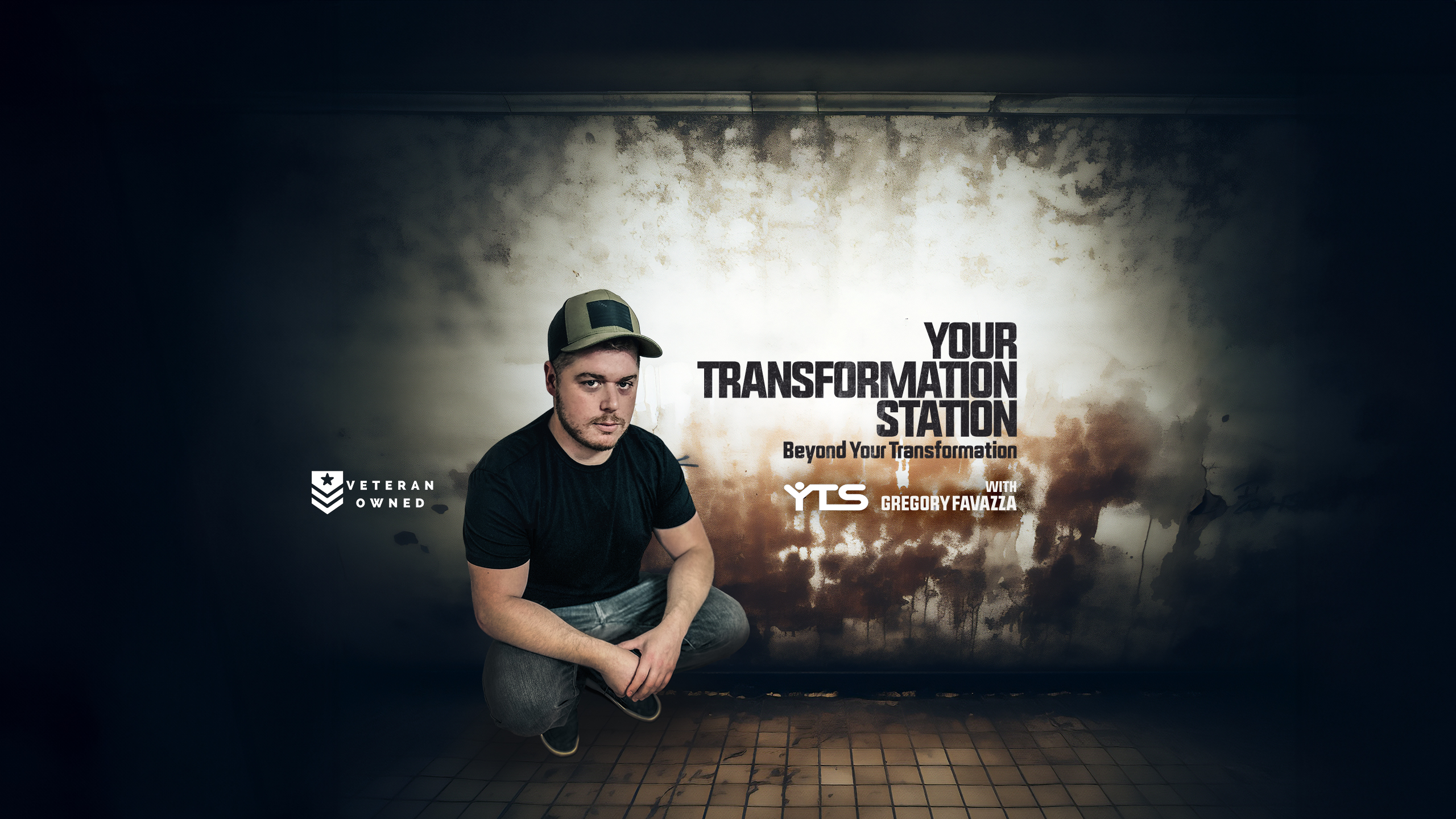
Gregory Favazza: Veteran, Host, Leadership Expert
Gregory Favazza is the host of Your Transformation Station, a podcast focused on clarity, discipline, and the psychological mechanics behind real change.
He holds a Master’s degree in Industrial Organizational Psychology and a Bachelor’s degree in Organizational Leadership. His academic training is paired with lived experience as a military veteran who has operated inside high pressure systems where performance, morale, and accountability are not theoretical concepts. They are survival skills.
Gregory approaches transformation clinically rather than motivationally. His conversations cut through surface level advice and expose the systems beneath behavior. Power dynamics. Incentives. Identity. Emotional regulation. Accountability. He challenges guests and listeners to stop reacting, start reading situations accurately, and lead themselves with precision.
His style is direct, controlled, and intentionally uncomfortable for anyone addicted to excuses or performance based confidence. Your Transformation Station attracts leaders, creators, and thinkers who value depth over hype and self control over noise. People who understand that change is not inspirational. It is operational. #podcasts #yourtransformationstation #leadership