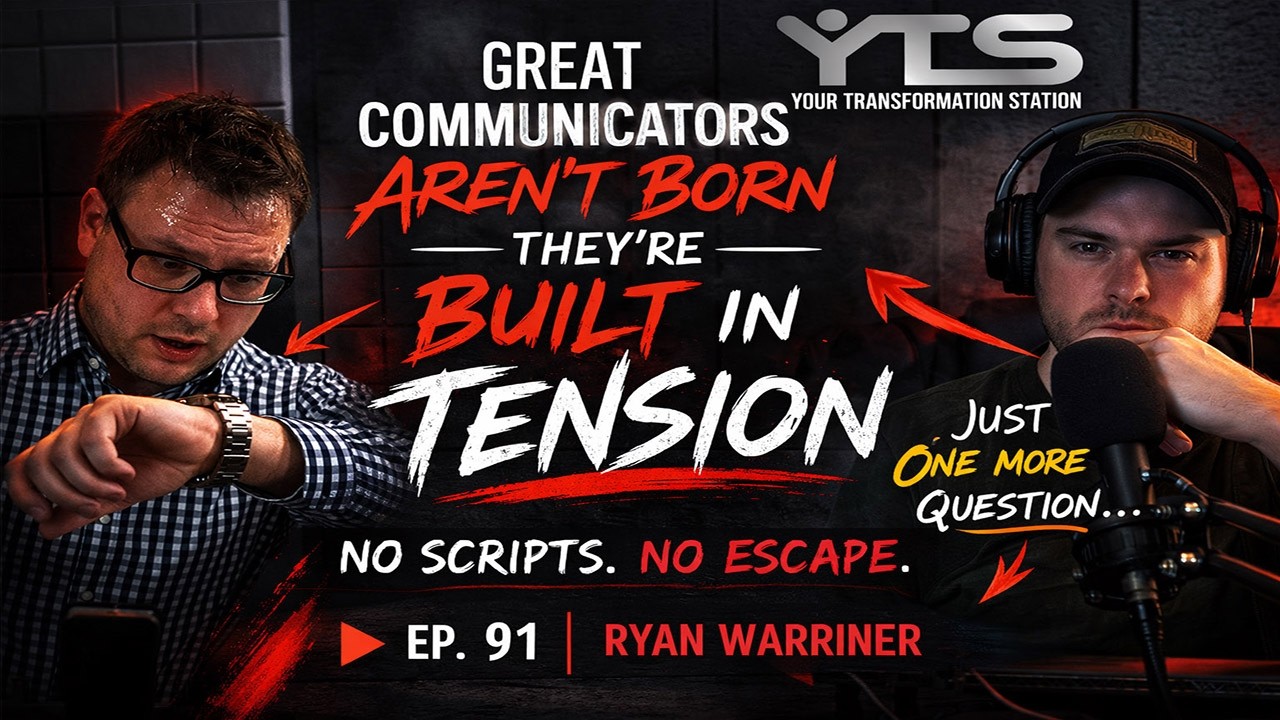
Breaking the Surface: How to Develop Transformational Communication Skills
Breaking the Surface: How to Develop Transformational Communication Skills
Welcome back to the blog, everyone! In our latest podcast episode, "#91: Ryan Warriner — Great Communicators Aren't Born, They're Pressure-Tested," we dove deep into the mechanics of what truly makes someone an exceptional communicator. It wasn't just about eloquent speeches or perfectly crafted sentences; it was about the grit, the resilience, and the intentional practice that goes into developing a voice that can truly connect and transform. This blog post is an extension of that conversation, expanding on the core ideas and offering actionable insights for all of you looking to elevate your own communication game. If you haven't listened to the episode yet, I highly recommend checking it out here. We’ll be exploring why simply sounding good isn't enough, and how embracing discomfort and cultivating a deep sense of curiosity are the keys to breaking free from surface-level speaking and achieving truly transformational communication.
The Illusion of Innate Communication Skills
One of the most pervasive myths surrounding communication is the idea that some people are simply "born with it." We see charismatic leaders, compelling storytellers, and persuasive negotiators, and we often chalk it up to natural talent. While personality traits and a certain ease with public speaking can certainly play a role, the truth is far more nuanced and, frankly, more empowering. Great communicators aren't born; they are meticulously crafted through intentional effort and a willingness to step outside their comfort zones. Think about any highly skilled profession. Do we believe surgeons are born with the ability to perform complex operations? Do we assume world-class athletes simply wake up with the prowess to win gold medals? Of course not. These individuals dedicate years to rigorous training, practice, and learning from their mistakes. Communication, a fundamental aspect of human interaction and leadership, deserves the same level of respect and dedication. The illusion of innate ability often serves as a convenient excuse for those who are unwilling to put in the work. It allows us to dismiss our own communication shortcomings without taking responsibility for improvement. In our podcast episode with Ryan Warriner, this theme was central. Ryan emphasized that the ability to communicate effectively, especially under pressure, is not an inherited trait but a learned skill. He shared how even the most polished speakers have faced their own share of awkward silences, misspoken words, and moments of panic. What separates them is not the absence of these challenges, but their developed strategies for navigating them, learning from them, and ultimately, growing stronger because of them. This shift in perspective – from innate talent to cultivated skill – is the first crucial step in developing transformational communication. It opens the door to recognizing that improvement is not only possible but entirely within your reach.
The Pressure Cooker: How Stress Forges Great Communicators
The idea that stress can be a catalyst for growth might sound counterintuitive. We often associate pressure with performance anxiety, mistakes, and a general feeling of being overwhelmed. However, when approached with the right mindset and preparation, high-pressure situations can be incredibly fertile ground for developing robust communication skills. This is where the "pressure-tested" aspect of our podcast episode with Ryan Warriner really shines. When you're put on the spot – whether it's during an unexpected Q&A, a difficult negotiation, or a crisis communication scenario – your usual communication habits are stripped away. You can't rely on pre-written scripts or leisurely thought processes. You are forced to think on your feet, articulate your thoughts concisely, and respond authentically. These moments, while uncomfortable, provide invaluable data. They reveal your immediate reactions, your areas of weakness, and your capacity for clear thinking under duress. Consider the analogy of an athlete training for a competition. They don't just practice in perfect conditions; they simulate the actual game day, including the crowd noise, the fatigue, and the unexpected twists and turns. This simulation builds resilience and muscle memory, enabling them to perform when the stakes are high. Similarly, communication professionals who thrive in demanding environments often engage in scenario-based training. They deliberately put themselves in challenging situations, not to fail, but to learn how to adapt, to remain composed, and to communicate effectively despite the surrounding chaos. This "pressure-testing" is not about enduring unnecessary suffering; it's about strategic exposure to challenges that accelerate learning and build a deeper, more resilient form of communication. It's in these moments of intense focus that we often discover capabilities we never knew we possessed.
Scenario-Based Practice: The Ultimate Training Ground
Building on the idea of pressure-testing, scenario-based practice emerges as one of the most effective and indispensable tools for developing transformational communication skills. It’s the bridge between theoretical knowledge and practical application, allowing individuals to experiment, make mistakes in a safe environment, and refine their approach before facing real-world consequences. What does scenario-based practice look like? It can take many forms, from role-playing difficult conversations with colleagues to rehearsing responses to potential media inquiries. It involves creating realistic situations that mimic the challenges you might encounter in your professional or personal life. For leaders, this could mean simulating a town hall meeting where tough questions are anticipated, or practicing how to deliver constructive feedback to an underperforming team member. For those in sales, it might involve role-playing objections from potential clients. The key is to create a space where you can practice your communication in a way that feels authentic to the situation, allowing you to experiment with different language, tone, and strategies. The beauty of this approach lies in its iterative nature. You can run through a scenario, analyze what worked and what didn't, make adjustments, and then run it again. This feedback loop is critical for learning and improvement. It's much easier to identify a flaw in your argument or an awkward phrasing when you're not also dealing with the pressure of a live audience or a critical stakeholder. The insights gained from these practice sessions are invaluable. They allow you to anticipate potential pitfalls, develop contingency plans, and build confidence in your ability to handle a wide range of communication challenges. As highlighted in our discussion with Ryan Warriner, this deliberate practice is what truly separates those who merely speak from those who communicate with impact and influence.
Adaptability: The Mark of an Exceptional Speaker
In today's rapidly evolving world, rigidity in communication is a recipe for obsolescence. Exceptional speakers are not those who stick to a pre-ordained script, but those who can seamlessly adapt to the ever-changing dynamics of a conversation, audience, or situation. Adaptability is the hallmark of a truly transformational communicator. Think about it: a prepared speech is valuable, but what happens when the audience presents an unexpected question that deviates from your planned remarks? Or when the mood of a room shifts, requiring a change in tone or approach? A rigid communicator might falter, becoming flustered or sticking rigidly to their original plan, thus missing an opportunity to connect. An adaptable communicator, however, sees these shifts not as disruptions, but as invitations to engage more deeply. Adaptability in communication involves several key components. Firstly, it requires active listening. You need to be fully present, paying attention not just to the words being spoken, but also to the non-verbal cues, the underlying emotions, and the overall context. Secondly, it demands mental agility. This is the ability to process new information quickly, make connections, and adjust your message on the fly without losing sight of your core objective. Thirdly, it involves emotional intelligence. Understanding the emotional state of your audience allows you to tailor your message to resonate with them, even if it means deviating from your initial plan. Ryan Warriner, in our podcast, spoke extensively about the importance of this flexibility. He illustrated how great communicators can pivot their message, respond to challenges with grace, and maintain their composure even when faced with the unexpected. This isn't about being a chameleon who changes their message to please everyone; it's about being responsive, empathetic, and strategically flexible. It’s about understanding that communication is a dynamic, two-way street, and the ability to navigate its turns and shifts with skill is what truly defines an exceptional speaker.
Leadership Communication: Common Misconceptions
Effective leadership communication is a complex and often misunderstood area. Many leaders fall prey to common misconceptions that can hinder their ability to connect with, inspire, and guide their teams. One of the most prevalent myths is that leadership communication is solely about delivering directives and making pronouncements from on high. This hierarchical view often leads to one-way communication, where the leader speaks, and the team listens, but genuine dialogue and feedback are stifled. Another common misconception is that powerful communication means using jargon or overly complex language to project intelligence and authority. In reality, the most effective leaders communicate with clarity and simplicity, ensuring their message is accessible to everyone. Using complex language often creates barriers rather than fostering understanding. Furthermore, many leaders believe that admitting uncertainty or a lack of knowledge is a sign of weakness. In truth, acknowledging limitations and demonstrating a willingness to learn can foster trust and build rapport. It shows authenticity and humility, qualities that resonate deeply with teams. Perhaps the most damaging misconception is that communication skills are a "soft skill" that can be deprioritized in favor of more "hard" business metrics. However, the ability to inspire, motivate, and align a team is directly tied to the effectiveness of leadership communication. A disconnect between a leader's vision and their ability to articulate it can lead to confusion, disengagement, and ultimately, poor performance. As we explored with Ryan Warriner, true leadership communication is about fostering an environment of trust, encouraging open dialogue, and inspiring action through authentic and clear messaging. It's about building bridges, not walls, between leaders and their teams.
Breaking Free: Overcoming Surface-Level Speaking
We all know what surface-level speaking sounds like. It's the polite small talk that never really goes anywhere, the generic platitudes that lack genuine feeling, or the rehearsed answers that feel rehearsed. While these forms of communication have their place, they rarely lead to deep connection or significant change. Breaking free from this habit requires a conscious effort to go deeper, to uncover the underlying meaning, and to express ourselves with authenticity and vulnerability. The first step in breaking free is recognizing the limitations of surface-level communication. It’s like skimming the surface of a lake without ever exploring the depths below. You get a general idea, but you miss the rich ecosystem and the hidden wonders. To break free, we need to challenge ourselves to ask "why" more often. Why are we saying this? What is the underlying intent? What is the impact we want to have? Cultivating curiosity is a powerful antidote to surface-level speaking. When we are genuinely curious about the topic, about the people we are speaking with, and about the potential for deeper understanding, our communication naturally becomes more engaging and meaningful. This curiosity prompts us to ask probing questions, to listen more intently, and to seek out connections that go beyond the obvious. It encourages us to move past assumptions and explore nuances. Furthermore, embracing vulnerability is essential. Surface-level communication often serves as a protective shield, keeping us from revealing our true thoughts and feelings. To communicate transformational, we must be willing to be a little uncomfortable, to share our perspectives, and to express our genuine emotions. This doesn't mean oversharing or becoming overly emotional; it means being authentic and allowing others to see the person behind the words. By consciously choosing to engage with curiosity and a willingness to be vulnerable, we can begin to dismantle the habits of surface-level speaking and pave the way for more impactful and meaningful interactions.
The Power Duo: Discomfort and Curiosity in Communication
If there's one overarching takeaway from our conversation with Ryan Warriner and this blog post, it's the symbiotic relationship between discomfort and curiosity. These two forces, when harnessed effectively, are the engine of transformational communication. Discomfort, as we've discussed, is often the indicator that we are pushing beyond our familiar boundaries. It’s the signal that we are engaging with challenging ideas, stepping into unfamiliar territory, or attempting to articulate something that is not yet fully formed. Instead of shying away from this discomfort, we should view it as an opportunity. It's during these moments of mild unease that our brains are most actively engaged, processing new information and forging new neural pathways. When we push through discomfort, we build resilience, we expand our capabilities, and we gain confidence in our ability to handle challenging situations. Curiosity, on the other hand, is the compass that guides us through this landscape of discomfort. It's the innate drive to explore, to understand, and to learn. When we approach situations with curiosity, we are less likely to feel threatened by the unknown. Instead, we see it as an adventure, an opportunity to discover something new. Curiosity fuels our desire to ask questions, to listen deeply, and to seek out different perspectives. It transforms potential moments of awkwardness into opportunities for genuine connection and deeper understanding. Together, discomfort and curiosity create a powerful synergy. Curiosity prompts us to lean into challenging situations (discomfort), and the growth we experience from navigating that discomfort, fueled by our curiosity, leads to even deeper exploration. This cycle of embracing discomfort and actively engaging curiosity is not a one-time event; it's an ongoing journey. It's the commitment to continuous learning, to challenging our own assumptions, and to approaching every communication opportunity as a chance to grow and to connect on a more profound level. This is the essence of transformational communication.
Conclusion: Embracing the Journey to Transformational Communication
As we wrap up this exploration, it’s clear that developing transformational communication skills is not about finding a magic formula or a set of perfectly crafted phrases. It’s about embracing a mindset of continuous growth, courage, and genuine connection. Our recent podcast episode, "#91: Ryan Warriner — Great Communicators Aren't Born, They're Pressure-Tested," perfectly encapsulated this idea. Ryan’s insights reinforced that true communication prowess is forged in the crucible of experience, often under pressure, and that the ability to adapt and connect authentically is paramount. We’ve delved into the illusion of innate talent, highlighting that great communicators are made, not born. We’ve examined how pressure, when met with the right preparation and mindset, can be a powerful catalyst for skill development, and how scenario-based practice offers a vital training ground. We’ve underscored adaptability as the hallmark of an exceptional speaker and dissected common misconceptions surrounding leadership communication. Crucially, we’ve explored how breaking free from surface-level speaking is achieved by embracing the powerful duo of discomfort and curiosity. The journey to transformational communication is ongoing. It requires a willingness to step outside your comfort zone, to be open to new learning, and to consistently practice. By embracing discomfort, cultivating a deep sense of curiosity, and committing to deliberate practice, you can elevate your communication from merely functional to truly transformational. Thank you for joining me in this exploration, and I encourage you to revisit the podcast episode here for even more in-depth insights. Keep practicing, keep questioning, and keep connecting – the world needs your authentic voice.

Business Development Specialist | M.S. Industrial‑Organizational Psychology | U.S. Army Veteran
I’m exhausted. Honestly, I’m just bone-deep burned out.
People love to say "just do it" or "do the work," but that’s a load of BS when your brain isn't wired that way. I’m an introvert with a relentless ambition, but being neurodivergent means I’m constantly trying to run a race on hardware that’s missing the manual. I’ve spent years masking and pretending I had it handled, while the stress just leaked out—snapping at people and hitting a wall because I never had the Executive Function systems I should’ve had from day one.
Giving up looks really tempting right now. Like, every single day.
But I’m not quitting. This is my personal laboratory for Modern Survival. I don’t have the answers, and I’m definitely not a guru. I’m just in the wreckage in real-time, trying to bring cogency and clarity to the depth of this mess.
I’m sharing my actual failures as I try to build these five pillars:
Digital: Building Productivity Systems and a Second Brain flow so my head doesn't explode from the cognitive load.
Physical: Biohacking the "dad bod" hardware and focusing on Longevity so my body actually supports my brain.
Leadership: Learning High-Stakes Communication and how to stand my ground when the pressure gets high.
Mental: Mastering Emotional Intelligence and figuring out how to actually regulate my own head.
Personal: Dropping the mask to find Authentic Leadership that doesn't feel like a 24/7 performance.
I’m building this because I wish someone had just …Read More