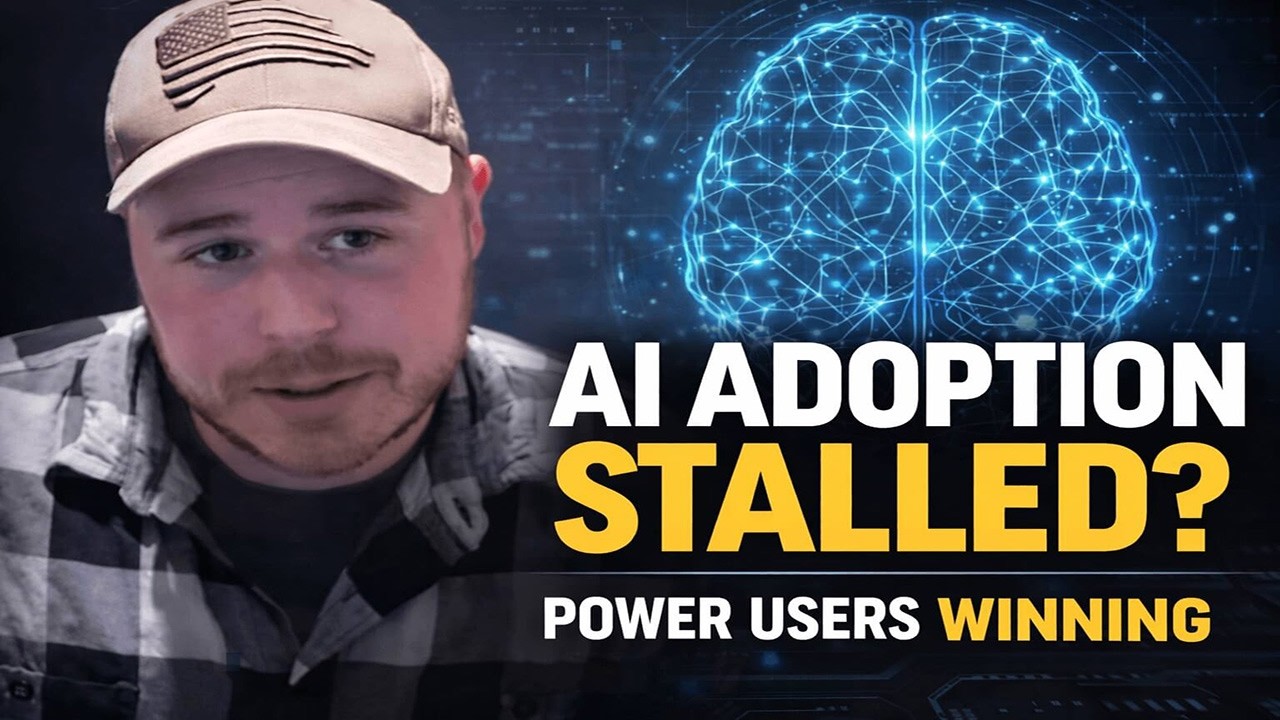
The AI Adoption Paradox: Why 2026 Isn't What We Expected

In our latest episode, 137. AI at Work 2026: Why Adoption Has Stalled but Power Users Are Pulling Ahead, we delved into some truly fascinating and, frankly, unexpected findings about the state of Artificial Intelligence in the workplace. The hype surrounding AI has been deafening, promising a revolution by now. Yet, as we discussed, the reality is far more nuanced. This blog post aims to expand on those core findings from the Gallup study, exploring why AI adoption has plateaued for many, what's really happening with those who are embracing it, and what this paradox means for the future of how we work. Get ready to unpack the data and understand the real story behind AI's integration into our professional lives.
The AI Hype vs. Reality: What 2026 Actually Looks Like
The narrative surrounding AI for the past few years has been one of relentless acceleration. We were promised widespread integration, seamless workflow enhancements, and a significant shift in how every professional operates. Think flying cars and robot assistants, but for your inbox and spreadsheets. The vision was of a world where AI was as ubiquitous as the internet is today, an indispensable tool woven into the fabric of our daily work lives. We were led to believe that by 2026, AI wouldn't just be a novelty; it would be a fundamental requirement for efficiency and competitiveness.
However, the reality, as revealed by robust research like Gallup's latest workforce study, paints a much more complex picture. Instead of a universal adoption, we're seeing a stark divergence. While some individuals and organizations are indeed leveraging AI to achieve remarkable gains, a significant portion of the workforce remains on the sidelines. This isn't a failure of the technology itself, but rather a reflection of the intricate challenges involved in its widespread and equitable implementation. The "AI revolution" isn't a single, sweeping wave; it's a series of smaller, more distinct currents, with some moving rapidly and others barely stirring the surface. This blog post aims to dissect these currents, moving beyond the headlines and into the data that truly defines the current AI landscape in the workplace.
Gallup's Workforce Study: Unpacking the Data
At the heart of our discussion in episode 137 and this blog post is the critical research conducted by Gallup. For those unfamiliar, Gallup is renowned for its rigorous approach to data collection and analysis, particularly concerning workforce trends. Their studies are considered a gold standard because they delve deep into the experiences and perceptions of actual workers, providing a grounded perspective that often contrasts with the more speculative pronouncements from tech evangelists.
The latest Gallup Workforce Study highlights a crucial paradox: while the overall adoption rate of AI tools in the workplace has stalled, a smaller, highly engaged segment of the workforce, dubbed "power users," is exhibiting accelerated AI mastery. This means that the numbers of people *using* AI haven't dramatically increased across the board, but the intensity and proficiency of use among those who *are* using it has significantly climbed. Gallup's data points to some eye-opening statistics. For instance, a substantial portion of U.S. workers—nearly half—report never using AI tools in their professional capacity. This figure is a stark reminder that the widespread integration we anticipated hasn't materialized for a significant majority. Yet, simultaneously, the study indicates a rise in *daily* and *frequent* AI use among those who have embraced it. This creates a bifurcated environment, where AI is either a non-existent entity or a deeply integrated companion for a select group.
Furthermore, the study sheds light on the disparity in AI usage between different roles and levels within organizations. Leaders, for example, are using AI at twice the rate of their direct reports. This suggests that AI adoption is often top-down, with those in management positions more likely to explore and implement these tools, potentially to enhance their oversight and strategic capabilities. Another significant finding relates to work environment: remote-capable roles are adopting AI at double the rate of on-site workers. This correlation points towards the nature of tasks suitable for AI augmentation and the environments that foster experimentation and adoption. The detailed breakdown of these statistics is essential for understanding the granular reality of AI integration, moving beyond the broad strokes of hype and into the specific dynamics at play in today's workplaces.
The Stalled Adoption: Why Aren't More Workers Using AI?
The question that immediately arises from Gallup's findings is simple yet profound: why has AI adoption stalled for so many? If the tools are so powerful, and the potential benefits so great, why are nearly half of U.S. workers still not engaging with them? The reasons are multifaceted and extend beyond mere technological availability. We can attribute this plateau to a combination of factors, including a lack of awareness, insufficient training, perceived complexity, and organizational inertia.
Firstly, there's a significant gap in awareness and understanding. Not everyone in the workforce is intimately familiar with the capabilities of modern AI tools. While headlines scream about generative AI, many employees may not see how these tools directly translate to their day-to-day tasks. There's a disconnect between the abstract concept of AI and its practical application in specific job functions. For many, AI remains an enigmatic technology, best left to the IT department or the tech-savvy few.
Secondly, and perhaps more crucially, is the issue of training and support. Simply providing access to AI tools is insufficient. Employees need comprehensive training on how to use these tools effectively and ethically. They need to understand what AI can and cannot do, and how it can augment their work rather than replace it. Without proper guidance, many individuals are likely to feel overwhelmed or intimidated, leading them to avoid engaging with the technology altogether. Organizations that fail to invest in robust AI literacy programs are inadvertently creating barriers to adoption.
Furthermore, the perceived complexity of AI tools can be a major deterrent. While some AI interfaces are designed to be user-friendly, others can be daunting, requiring a degree of technical proficiency or a steep learning curve. For workers already managing demanding workloads, the added effort of learning a new, complex system might feel like an insurmountable obstacle. This is particularly true for individuals who may not have a background in technology or data science.
Finally, organizational inertia plays a significant role. Even if individual employees are curious or willing to experiment, company culture, established workflows, and a lack of strategic vision for AI integration can create a stagnant environment. If leadership doesn't champion AI adoption, allocate resources, and visibly demonstrate its value, it's unlikely that a significant cultural shift will occur. The status quo often holds a powerful sway, and breaking free requires deliberate effort and clear direction from the top. These interconnected reasons help explain why the AI revolution, while present for some, has yet to truly permeate the entire workforce.
The Rise of the Power User: AI Mastery Accelerates
While the broad adoption of AI has stalled, the other side of Gallup's paradox is the rapid acceleration of AI mastery among a select group of "power users." These individuals aren't just dabbling; they are deeply integrating AI into their workflows, becoming highly proficient and deriving significant value. This phenomenon is not merely about using AI tools more often; it's about using them smarter, more effectively, and in ways that fundamentally enhance their productivity and output.
These power users are often the early adopters, the innovators within their organizations who are unafraid to experiment and learn. They are likely to be individuals who are already comfortable with technology and see AI as a natural extension of their digital toolkit. They might be proactively seeking out new AI applications, attending webinars, taking online courses, or engaging in peer-to-peer learning to hone their skills. Their motivation stems from a clear understanding of AI's potential to solve problems, streamline tasks, and unlock new capabilities within their roles.
What distinguishes these power users is their ability to move beyond basic functionalities. They understand how to craft effective prompts for generative AI, how to integrate AI-powered analytics into their decision-making processes, and how to leverage AI for creative tasks such as content generation or code assistance. They are adept at identifying the right AI tool for the right job and are capable of nuanced application, rather than simply using AI as a blunt instrument. This mastery allows them to achieve levels of efficiency and innovation that far surpass those who are not using AI, or who are using it only superficially.
This emerging class of AI experts is not only benefiting themselves but also has the potential to influence and uplift their teams and organizations. As they demonstrate tangible results, they can serve as internal champions, showcasing the value of AI and encouraging others to follow suit. Their advanced skills could also lead to the development of new best practices and workflows that can be scaled across the organization. The acceleration of AI mastery among these power users is a critical indicator of AI's future trajectory, highlighting the importance of nurturing and supporting these individuals as they pave the way for broader AI integration.
Bridging the Divide: Leaders, Remote Workers, and AI Adoption
Gallup's research also illuminates significant divides in AI adoption based on roles and work environments, providing key insights into where and why AI is taking hold more readily. The disparities between leaders and their teams, and between remote and on-site workers, are particularly telling and offer clues for accelerating adoption across the board.
As previously mentioned, leaders are using AI at twice the rate of their teams. This statistic suggests a couple of potential drivers. Firstly, leaders are often tasked with strategic planning and decision-making, areas where AI can offer powerful analytical and predictive capabilities. They might be using AI to gain deeper insights into market trends, customer behavior, or operational efficiency. Secondly, leaders are often the ones driving change and innovation within organizations. If they are experimenting with and championing AI, it can create a top-down impetus for adoption throughout their departments. However, this also highlights a potential challenge: if leaders are the primary users, the benefits of AI might not be trickling down effectively to the individuals performing the day-to-day tasks, leading to a widening skill and productivity gap.
The contrast between remote-capable roles and on-site workers is equally significant. Remote-capable roles are adopting AI at double the rate of their on-site counterparts. This correlation can be attributed to several factors. Remote work often necessitates greater reliance on digital tools and asynchronous communication, making AI integration a more natural fit for enhancing virtual collaboration, productivity, and task management. Moreover, roles that are inherently remote-capable often involve tasks that are more easily digitized and augmented by AI, such as data analysis, content creation, or customer support through digital channels. On-site roles, especially those that are more manual or require a strong physical presence, might have fewer immediate AI applications or face greater resistance to introducing new technologies into established physical workflows. Understanding these differences is crucial for tailoring AI adoption strategies to specific work contexts and employee needs.
Industry Spotlight: Who's Accelerating and Who's Falling Behind?
The impact of AI adoption is not uniform across all sectors of the economy. Gallup's data, as discussed in episode 137, provides a glimpse into which industries are embracing AI with gusto and which are lagging. This industry-specific analysis is vital for understanding the broader economic implications of AI and for identifying sectors that may require targeted support or strategic intervention.
While the specific industries showing the most acceleration or lag can fluctuate, the general trends often point towards sectors that are already digitally mature and have a strong focus on data-driven decision-making. Industries like technology, finance, and professional services, which are heavily reliant on information processing and analytics, are typically at the forefront of AI adoption. These sectors often have the resources, the talent pool, and the pressing need for efficiency and innovation that AI can provide. They are more likely to have established data infrastructure and a culture that encourages experimentation with new technologies.
Conversely, industries that are more traditionally rooted, with a higher proportion of manual labor, complex supply chains, or significant regulatory hurdles, may find AI adoption more challenging. Sectors such as manufacturing (particularly in areas not yet automated), agriculture, and some segments of healthcare or retail might be seeing slower uptake. This doesn't mean AI has no role in these industries, but rather that the path to integration might be longer, more complex, and require specialized AI solutions tailored to their unique operational contexts. For example, AI in manufacturing might focus on predictive maintenance or quality control, while in agriculture it could involve precision farming. Identifying these laggard industries is not about criticism but about recognizing areas where focused investment, tailored training programs, and industry-specific AI development are most needed to ensure that no sector is left behind in the digital transformation.
Beyond Coding: What Employees Actually Use AI For
One of the most persistent misconceptions about AI in the workplace is that its primary utility lies in assisting developers with coding. While AI-powered coding assistants are indeed powerful tools, the reality of how most employees are using AI is far broader and more diverse. Gallup's findings shed light on the practical, everyday applications of AI that are driving adoption for the average worker.
For many, AI is becoming an indispensable tool for enhancing communication and content creation. This includes tasks like drafting emails, summarizing lengthy documents, generating reports, creating presentation outlines, and even brainstorming ideas. Generative AI tools, in particular, are proving invaluable for overcoming writer's block and accelerating the creation of written and visual content. Employees are using AI to automate repetitive writing tasks, allowing them to focus on higher-level strategic thinking and refinement.
Beyond content, AI is also being leveraged for research and information synthesis. Employees are using AI to quickly gather and process information from vast datasets, identify trends, and extract key insights. This is particularly useful in roles that require extensive research or analysis. Imagine a marketing professional using AI to analyze customer feedback across various platforms, or a financial analyst using it to scour market reports for investment opportunities.
Furthermore, AI is being applied to improve efficiency in administrative tasks. This can include scheduling meetings, managing calendars, organizing data, and even assisting with customer service inquiries through AI-powered chatbots. The goal is often to offload mundane and time-consuming tasks, freeing up employees to focus on more complex, strategic, and engaging aspects of their roles. This shift from niche technical applications to broad-based productivity enhancers is a key indicator of AI's maturing role in the modern workplace, moving beyond the realm of coders and into the hands of virtually any knowledge worker.
The #1 Barrier to Wider AI Adoption
After dissecting the various facets of AI adoption—the stalled progress, the rise of power users, the disparities among roles and industries, and the diverse applications—a critical question remains: what is the single biggest obstacle preventing AI from becoming universally integrated into the workplace? Gallup's research points to a clear answer, and it's not a lack of technology or talent, but rather a foundational issue within organizations themselves.
The #1 barrier to wider AI adoption, as identified by the study, is the lack of a clear and compelling strategy for AI integration at the organizational level. This is not about a lack of individual desire to use AI, nor is it solely about insufficient training, though those are contributing factors. Instead, it's the absence of a comprehensive vision from leadership about *why* AI is important, *how* it aligns with business objectives, and *what steps* will be taken to implement it effectively and equitably across the workforce. Without this strategic roadmap, AI adoption often remains fragmented, opportunistic, and ultimately, superficial. Organizations that are excelling with AI are those that have a deliberate strategy that outlines their goals, identifies key use cases, invests in the necessary infrastructure and training, and fosters a culture that embraces technological advancement.
This strategic deficit can manifest in several ways. It can lead to a scattershot approach where departments or individuals adopt tools haphazardly without coordination. It can result in a failure to address ethical concerns or data privacy issues proactively. Crucially, it can perpetuate the divide between AI-savvy employees and those who are left behind, as there's no overarching plan to ensure inclusive development and skill-building. Therefore, for organizations looking to truly harness the power of AI, the imperative is to move beyond ad-hoc experimentation and develop a robust, organization-wide AI strategy that guides every step of the adoption journey.
The Future of Work: Implications of the AI Adoption Paradox
The AI adoption paradox—where widespread adoption has stalled while AI mastery accelerates among a select group—has profound implications for the future of work. As we've explored throughout this blog post and in our recent episode, this isn't just a temporary trend; it's shaping the very landscape of the modern workplace and will continue to do so in the years to come.
One of the most significant implications is the potential for a widening productivity and skills gap. The power users who are deeply integrating AI into their roles are likely to become increasingly efficient, innovative, and valuable to their organizations. Meanwhile, those who remain on the sidelines, either due to lack of access, training, or strategic direction, may find their skills becoming less relevant. This could lead to increased job stratification, where highly skilled AI-augmented workers command premium roles and compensation, while others face greater challenges in maintaining their career trajectory. Organizations must actively work to bridge this divide by ensuring equitable access to AI tools and comprehensive training for all employees.
Furthermore, the disparity in adoption between leaders and their teams, and between remote and on-site workers, highlights the need for tailored AI integration strategies. Simply deploying AI tools universally won't suffice. Effective implementation requires understanding the specific needs and contexts of different roles and work environments. This means that leadership development programs will need to incorporate AI proficiency, and companies will need to explore how AI can best support both in-office and remote workforces. The future of work will likely see a more distributed and adaptable approach to technology adoption.
The industry-specific trends also suggest a future where certain sectors will experience more rapid transformation than others. This could lead to shifts in economic power and the emergence of new industry leaders. It also underscores the importance of proactive workforce development initiatives within industries that are slower to adopt AI, ensuring they can remain competitive and their workers can adapt to evolving demands.
Ultimately, the AI adoption paradox is a call to action for organizations. It signals that the future of work is not about simply adopting AI, but about strategically and thoughtfully integrating it. This requires visionary leadership, a commitment to continuous learning and development, and a focus on ensuring that the benefits of AI are shared broadly across the workforce. As we navigate this complex transition, understanding the data and the underlying dynamics, much like we did in episode 137, is the first and most crucial step towards building a future where AI truly empowers everyone.
Key Topics In This Article
AI at work 2026, AI adoption paradox, artificial intelligence in leadership, future of work and AI, AI productivity gap, generative AI in organizations, leadership decision making and AI, human AI collaboration, AI strategy for leaders, AI capability gap, digital transformation leadership, organizational psychology and AI, workplace technology adoption, AI productivity research, AI leadership challenges

Business Development Specialist | M.S. Industrial‑Organizational Psychology | U.S. Army Veteran
I’m exhausted. Honestly, I’m just bone-deep burned out.
People love to say "just do it" or "do the work," but that’s a load of BS when your brain isn't wired that way. I’m an introvert with a relentless ambition, but being neurodivergent means I’m constantly trying to run a race on hardware that’s missing the manual. I’ve spent years masking and pretending I had it handled, while the stress just leaked out—snapping at people and hitting a wall because I never had the Executive Function systems I should’ve had from day one.
Giving up looks really tempting right now. Like, every single day.
But I’m not quitting. This is my personal laboratory for Modern Survival. I don’t have the answers, and I’m definitely not a guru. I’m just in the wreckage in real-time, trying to bring cogency and clarity to the depth of this mess.
I’m sharing my actual failures as I try to build these five pillars:
Digital: Building Productivity Systems and a Second Brain flow so my head doesn't explode from the cognitive load.
Physical: Biohacking the "dad bod" hardware and focusing on Longevity so my body actually supports my brain.
Leadership: Learning High-Stakes Communication and how to stand my ground when the pressure gets high.
Mental: Mastering Emotional Intelligence and figuring out how to actually regulate my own head.
Personal: Dropping the mask to find Authentic Leadership that doesn't feel like a 24/7 performance.
I’m building this because I wish someone had just …Read More

How Conversations Change Under Pressure