Visual Storytelling vs. Direct Evidence: The Role of Media in Shaping Reality

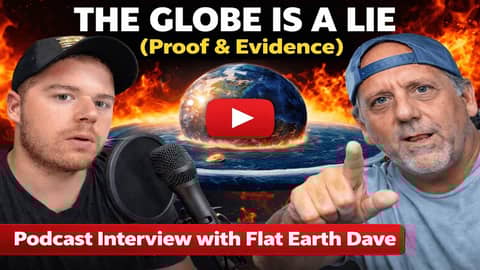
Welcome back to the blog, everyone! In our latest podcast episode, titled "(Flat Earth Dave) — Challenging the Globe: David Weiss on the Flat Earth Perspective (#72)," we dove headfirst into a conversation that challenges our fundamental understanding of how we perceive reality, especially within the realm of science and exploration. You can listen to the full episode here: Flat Earth Dave — Challenging the Globe: David Weiss on the Flat Earth Perspective (#72). Today, we're going to expand on the fascinating points raised, particularly concerning the power of visual storytelling and its potential to influence our beliefs, even in seemingly concrete scientific domains like space exploration. We'll explore the journey from accepting established narratives to questioning them, and the crucial difference between passively consuming information and actively seeking direct evidence. This isn't just about flat earth theories; it's about how we all form our worldviews in an age saturated with media.
The Power of Images and Science
We live in a visually driven world. From the stunning images broadcast back from the Hubble Telescope to the meticulously crafted CGI of blockbuster space movies, visuals play an enormous role in shaping our understanding of the universe and our place within it. This is particularly true when discussing complex scientific concepts that are often beyond our direct sensory experience. Who among us has personally traveled to the edge of the solar system or walked on the surface of Mars? Our knowledge, for the most part, is mediated through images, videos, and narratives presented to us by trusted institutions and captivating storytellers.
This is where the episode with Flat Earth Dave becomes so thought-provoking. Dave's journey, as he describes it, began not with a pre-existing belief in a flat earth, but with an attempt to debunk it. His initial efforts to prove the globe model led him down a rabbit hole of questioning the very evidence presented by organizations like NASA. He found himself increasingly swayed by alternative interpretations of visual data, by perceived inconsistencies in photographic and video evidence, and by narratives that suggested a grand deception. This highlights a critical point: the way information is presented, especially visually, can be incredibly persuasive, sometimes overriding the need for rigorous, independent verification.
Visual Storytelling in Science: A Double-Edged Sword
In many ways, visual storytelling has been a powerful tool for advancing scientific understanding and public engagement. Think of the iconic images of Earth from space, images that have fostered a sense of global unity and environmental awareness. Think of the breathtaking nebulae captured by telescopes, sparking wonder and curiosity about the cosmos. These visuals inspire, educate, and make the abstract tangible. They transform complex scientific theories into accessible, awe-inspiring realities.
However, this same power can be a double-edged sword. When visual information is presented as the sole or primary evidence, it can inadvertently discourage critical inquiry. If the images are compelling enough, if the narrative is sufficiently persuasive, the average person might see no need to question them. The "proof" is right there, on the screen. This is especially true when the source of the information is perceived as authoritative, like a government space agency. We've been conditioned to trust these institutions, and their visually rich presentations reinforce that trust. But what happens when that trust is eroded, or when the very nature of the visual evidence is called into question?
From Solar Energy to Flat Earth: Dave's Journey and the Seeds of Doubt
Dave's personal story, as shared in the podcast, is a powerful illustration of this dynamic. He wasn't a lifelong contrarian or a seeker of fringe theories. He was a successful businessman in the solar energy industry, someone who dealt with scientific principles on a daily basis. His transition to becoming a prominent flat earth advocate stemmed from a genuine desire to understand and to defend what he perceived as established truth. Yet, his process of dissection and analysis, his delving into the "why" behind the accepted model, led him to conclusions that deviated sharply from the mainstream. This trajectory underscores how an individual's pursuit of knowledge, when encountering the limitations or perceived inconsistencies of prevailing narratives, can lead to radical shifts in belief.
His narrative often involves questioning the authenticity of images and videos from space missions. He points to perceived anomalies, inconsistencies in lighting, shadows, or textures, and suggests that these might be indicators of artificial manipulation. While mainstream science offers explanations for these phenomena within established physics, Dave's interpretation prioritizes the possibility of fabrication. This is where the debate between visual storytelling and direct evidence becomes so stark. For those who accept the official narrative, the visuals are compelling evidence of a spherical Earth and space travel. For those who are skeptical, like Dave, the same visuals become suspect, seeds of doubt planted by what they interpret as a flawed or deliberately misleading presentation.
The Genesis of Belief: How We Form Our Worldviews
Understanding Dave's journey also compels us to examine how our own worldviews are formed. We are not born with inherent knowledge of physics, cosmology, or geography. These are concepts we absorb from our environment, our education, and the media we consume. From a young age, we are taught that the Earth is a globe, that gravity keeps us grounded, and that rockets can propel us into space. These ideas are often presented as indisputable facts, supported by visuals and reinforced by authority figures like teachers and scientists.
As Dave suggests, "Somebody told you." This simple yet profound statement points to the often passive nature of belief formation. We inherit a framework of understanding from our society and our upbringing. This framework becomes the lens through which we interpret new information. When new information aligns with our existing framework, it is readily accepted. When it challenges it, we often experience cognitive dissonance, and our inclination is to either reject the new information or find ways to reconcile it with our established beliefs. This is where the "seeds of doubt" can take root. If the visual evidence presented by NASA is the primary way we "know" the Earth is round, then any challenge to the authenticity of that evidence, however outlandish it may seem, can begin to unravel the entire belief system.
Challenging Authority: Skepticism Towards NASA and Space Narratives
The episode touches upon a deep-seated skepticism towards institutions like NASA. This skepticism, while often amplified by conspiracy theories, can also stem from broader societal trends of questioning authority and a growing awareness of historical instances where powerful entities have misled the public. When institutions that present themselves as arbiters of truth are perceived as having a hidden agenda or a history of deception, it naturally breeds distrust. In this context, any visual evidence presented by NASA – whether it's images of planets, videos of spacewalks, or depictions of celestial bodies – can be viewed with suspicion. Are these genuine representations of reality, or carefully constructed narratives designed to maintain a specific worldview?
Dave's arguments often revolve around the idea that the "globe model" is a narrative, a story told to us. He suggests that the visual "evidence" we see is part of this storytelling, designed to convince us of a particular reality. This perspective forces us to consider the difference between observation and interpretation. We see an image, but it's the narrative we attach to it, the context provided by the presenting authority, that shapes our understanding. When that authority is questioned, the interpretation itself becomes suspect, leading to a search for alternative explanations, even if those explanations lack robust empirical support in the traditional scientific sense.
The Distinction Between Passive Consumption and Active Seeking of Evidence
This is arguably the most crucial takeaway from our discussion: the difference between passively consuming information and actively seeking direct evidence. For many, the scientific consensus on the shape of the Earth and the reality of space exploration is accepted based on trust in institutions and the overwhelming visual evidence presented. This is passive consumption. We see a picture of Earth from space, we accept it as fact, and we move on. We watch documentaries about Mars, and we believe the images are real.
Actively seeking direct evidence, on the other hand, involves a more rigorous and personal process. It means asking questions, seeking out primary sources, attempting to replicate experiments, and critically evaluating the claims made by any authority, be it scientific, governmental, or otherwise. It means understanding the scientific method not just as something to be taught, but as something to be applied. It involves understanding the limitations of visual media and recognizing that images can be manipulated, selectively presented, or interpreted in various ways.
Dave's own journey exemplifies this active seeking, albeit with a divergent outcome. He didn't just accept the globe; he claims he tried to disprove the flat earth. This active engagement, even if it led him to a position many find untenable, highlights the potential pitfalls of relying solely on mediated information. The challenge for all of us is to cultivate a mindset of active inquiry, to question critically, and to differentiate between compelling storytelling and verifiable truth. This doesn't mean we should distrust all scientific institutions or dismiss all visual evidence. Instead, it means we should approach information with a healthy dose of skepticism and a commitment to understanding the underlying evidence, rather than simply accepting the narrative.
Broader Implications: Media, Control, and Perception
The implications of this discussion extend far beyond the realm of flat earth theories. In an era of pervasive media, from traditional news outlets to social media algorithms, the ability of visual storytelling to shape perception is more potent than ever. The way events are photographed, filmed, and edited can profoundly influence public opinion, political discourse, and even our understanding of global issues. The narratives that gain traction are often those that are most visually compelling or emotionally resonant, regardless of their factual accuracy.
This raises important questions about media literacy, critical thinking, and the potential for manipulation. If visual storytelling can be used to inspire wonder and educate, it can also be used to mislead and control. The episode alludes to broader theories of control systems, where media is seen as a tool for maintaining societal order and influencing public behavior. Whether one subscribes to these theories or not, the power of visual narratives to shape our reality is undeniable. It is a power that demands our attention and our critical engagement.
Conclusion: Navigating the Landscape of Information
Our conversation with Flat Earth Dave in episode 72 offered a fascinating, albeit controversial, lens through which to examine the complex relationship between media, perception, and truth. This blog post has sought to unpack some of the core themes: the compelling nature of visual storytelling, its role in scientific communication, and the potential for it to both enlighten and mislead. Dave's own journey from a business owner to a proponent of the flat earth model serves as a powerful, albeit extreme, example of how questioning established narratives, fueled by a critical examination of visual evidence, can lead individuals down unexpected paths of belief formation.
We've explored how our worldviews are often shaped by passive consumption and inherited beliefs, and how this can make us susceptible to narratives that resonate visually. The crucial distinction lies between accepting information at face value and actively seeking direct evidence. In a world saturated with information, cultivating critical thinking skills and a healthy skepticism towards all forms of presentation, including the visually stunning narratives put forth by institutions like NASA, is paramount. It's not about discrediting science, but about understanding the process of scientific discovery and the potential biases that can influence how information is presented. As we continue to navigate the ever-evolving landscape of information, remembering the power of visual storytelling and the importance of discerning between compelling narratives and verifiable facts will be our guiding principle. We encourage you to revisit the episode and continue this important conversation with us.

Business Development Specialist | M.S. Industrial‑Organizational Psychology | U.S. Army Veteran
I’m exhausted. Honestly, I’m just bone-deep burned out.
People love to say "just do it" or "do the work," but that’s a load of BS when your brain isn't wired that way. I’m an introvert with a relentless ambition, but being neurodivergent means I’m constantly trying to run a race on hardware that’s missing the manual. I’ve spent years masking and pretending I had it handled, while the stress just leaked out—snapping at people and hitting a wall because I never had the Executive Function systems I should’ve had from day one.
Giving up looks really tempting right now. Like, every single day.
But I’m not quitting. This is my personal laboratory for Modern Survival. I don’t have the answers, and I’m definitely not a guru. I’m just in the wreckage in real-time, trying to bring cogency and clarity to the depth of this mess.
I’m sharing my actual failures as I try to build these five pillars:
Digital: Building Productivity Systems and a Second Brain flow so my head doesn't explode from the cognitive load.
Physical: Biohacking the "dad bod" hardware and focusing on Longevity so my body actually supports my brain.
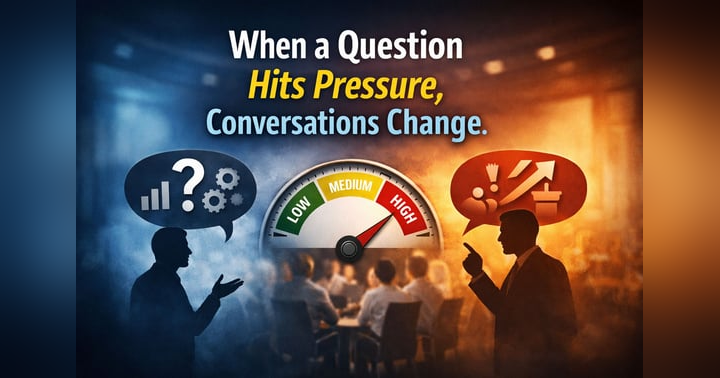
Leadership: Learning High-Stakes Communication and how to stand my ground when the pressure gets high.
Mental: Mastering Emotional Intelligence and figuring out how to actually regulate my own head.
Personal: Dropping the mask to find Authentic Leadership that doesn't feel like a 24/7 performance.
I’m building this because I wish someone had just …Read More
How Conversations Change Under Pressure